Northwest Indiana’s Concrete Experts

How Much Does a Concrete Driveway Cost in NWI?
- Home
- Blog
- Concrete Tips
- How Much Does a Concrete Driveway Cost in NWI?

What Should You Expect to Pay for a Concrete Driveway in NWI?
If you are thinking about installing a new concrete driveway or replacing an old one at your home in Northwest Indiana, one of the first questions on your mind is almost certainly about cost. How much does a concrete driveway actually cost in the Valparaiso, Crown Point, Portage, and greater NWI area? What factors drive the price up or down? And how can you make sure you are getting fair value for your investment without sacrificing quality?
These are smart questions, and getting clear, honest answers before you commit to a project is essential for making a confident decision. Unfortunately, concrete pricing can be confusing because there is no single fixed price that applies to every driveway. Costs vary based on a range of factors specific to your property, your design preferences, and the contractor you choose. The good news is that once you understand the key variables, you can evaluate estimates with a critical eye and budget accurately for your project.
At Black Rock Concrete, we believe in complete pricing transparency. We want every homeowner who contacts us to understand exactly what goes into the cost of a concrete driveway and why quality work costs what it does. This guide breaks down the real-world pricing factors for concrete driveways in the Northwest Indiana market as of 2026, giving you a practical framework for planning and budgeting your project.
Average Concrete Driveway Costs in Northwest Indiana
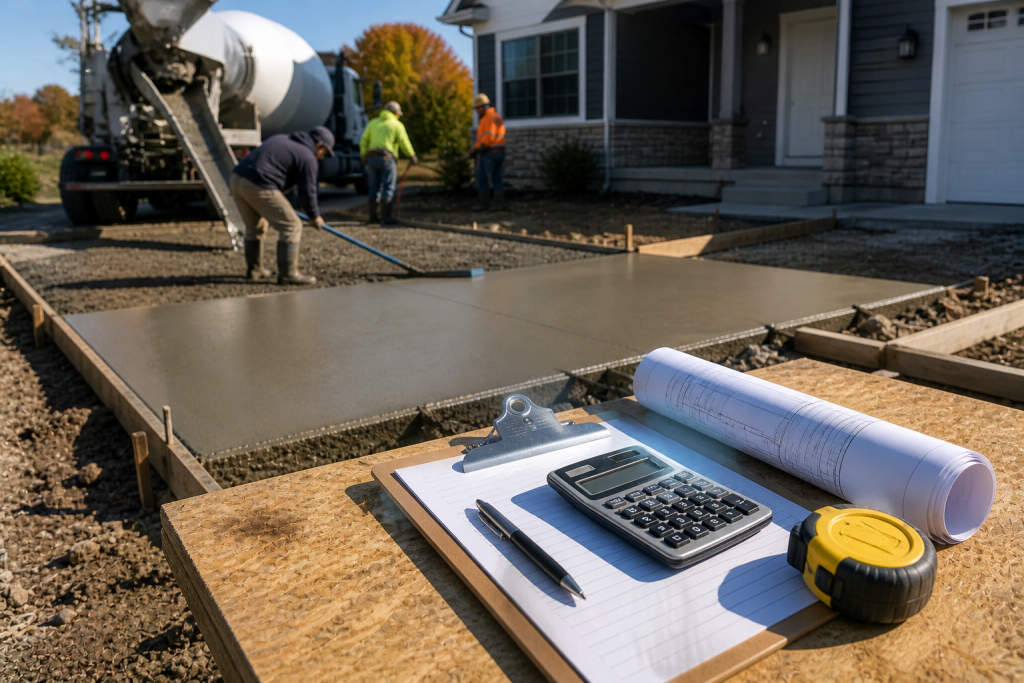
As a general starting point, homeowners in Northwest Indiana can expect to pay somewhere in the range of eight to fifteen dollars per square foot for a professionally installed standard concrete driveway with a broom finish, proper base preparation, and standard reinforcement. For a typical two-car driveway of approximately 600 to 800 square feet, that translates to a total project cost in the range of roughly five thousand to twelve thousand dollars, depending on the specific variables involved.
These numbers represent a broad range because no two driveway projects are exactly alike. A straightforward replacement on a well-prepared site with good access and simple geometry will come in toward the lower end of the range, while a project that involves significant demolition, challenging soil conditions, complex layouts, or extensive grading work will naturally fall toward the higher end. Decorative options like stamped concrete, colored concrete, and exposed aggregate finishes add additional cost beyond these baseline figures.
It is worth noting that pricing in Northwest Indiana tends to be competitive compared to the Chicago metropolitan area and other major urban markets. However, it is important to compare apples to apples when evaluating bids from different contractors. A significantly lower bid may reflect a contractor who is cutting corners on base preparation, using thinner concrete, skipping reinforcement, or planning to rush through critical finishing and curing steps. These shortcuts save money upfront but almost always result in premature failure that costs far more to fix than doing the job right the first time.

Key Factors That Affect Your Driveway Cost
Understanding the specific factors that influence your driveway’s cost empowers you to make informed decisions and have productive conversations with contractors. Here are the primary variables that determine what you will pay for your concrete driveway project in Northwest Indiana.
Driveway size is the most obvious cost factor, as more square footage means more material, more labor, and more time. However, it is important to understand that larger driveways often have a lower per-square-foot cost than smaller ones because certain fixed costs, such as mobilization, setup, and minimum material delivery charges, are spread over a greater area. So while your total cost increases with size, the unit price may actually decrease.
Demolition and removal of existing concrete adds to the project cost if you are replacing an old driveway rather than installing on a virgin site. The cost of demolition depends on the thickness and area of the existing concrete, the type of reinforcement present, and the accessibility of the site for equipment. Expect demolition and hauling to add several dollars per square foot to the project.
Site conditions and preparation requirements can significantly impact the total cost. If the subgrade soil is soft, unstable, or contains organic material that must be removed and replaced, additional excavation and fill work will be needed. Properties with drainage issues may require grading modifications, drain installation, or other improvements that add to the site preparation costs. Poor access for equipment and material delivery trucks can also increase labor time and costs.
Concrete thickness affects both material costs and the structural capacity of the finished driveway. The standard residential driveway thickness is four inches, but many contractors, including Black Rock Concrete, recommend upgrading to five or six inches for increased durability and load-bearing capacity, especially in areas that will support heavy vehicles like trucks, SUVs, and recreational vehicles. Thicker concrete costs more per square foot but provides significantly better long-term performance and resistance to cracking.
Reinforcement type and amount contribute to the project cost. Basic welded wire mesh is the most economical reinforcement option, while rebar provides greater structural strength at a higher cost. Fiber reinforcement, which is mixed directly into the concrete, adds crack resistance throughout the slab and can be used alone or in combination with traditional reinforcement. The appropriate reinforcement approach depends on the driveway’s thickness, the expected loads, and the soil conditions.
Finish type is one of the most significant cost variables for homeowners to consider. A standard broom finish is the most affordable option and delivers an attractive, functional surface. Stamped concrete, which replicates the appearance of natural stone, brick, or other materials, typically adds several dollars per square foot to the base price due to the additional materials, labor, and skill required. Integral coloring, exposed aggregate, and other decorative treatments each carry their own cost premiums that vary based on the complexity of the application.
Edge and border treatments, decorative scoring, expansion joint details, and other design elements can add cost to the project but also significantly enhance the finished appearance of the driveway. These features are often relatively modest in cost compared to their visual impact, making them popular upgrades among homeowners who want to add a custom touch without the full investment of a stamped surface.
Hidden Costs and Red Flags to Watch For
When comparing estimates from different contractors, it is important to look beyond the bottom-line number and examine what is included in each bid. Some common areas where costs can be hidden, understated, or omitted include the following.
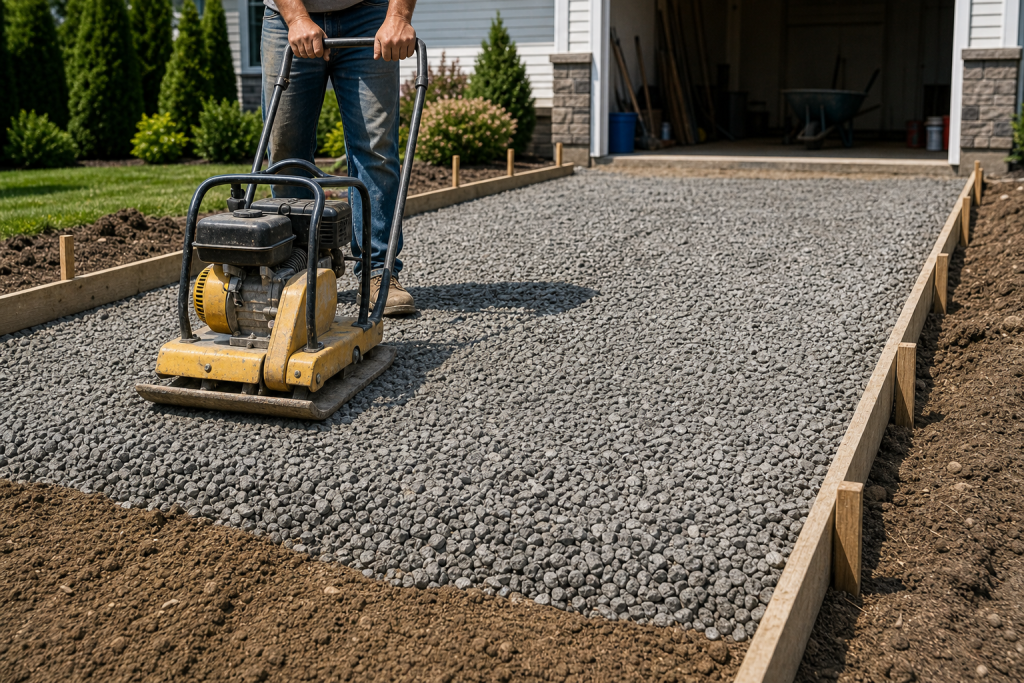
Base preparation is a critical cost component that some contractors minimize or omit from their estimates, either quoting an inadequate base thickness or planning to skip compaction steps that are essential for long-term performance. If a bid seems unusually low, ask specifically about the base preparation plan, including the type and depth of aggregate, the compaction method, and whether the cost of base material and labor is fully included.
Demolition and hauling costs for removing existing concrete should be clearly itemized in any replacement estimate. Some contractors quote a low price for the concrete work but add substantial charges for demolition that were not clearly communicated upfront.
Permit fees may be required by your municipality for driveway work, particularly for new installations or projects that affect the public right-of-way. Ask whether permit costs are included in the estimate or will be an additional charge.
Sealing is an important finishing step that protects the concrete surface and enhances its appearance. Some contractors include sealing in their base price while others treat it as an add-on. For decorative concrete in particular, sealing is essential and should be factored into your budget.
Be cautious of any estimate that seems dramatically lower than competing bids. While some price variation between contractors is normal and expected, a bid that is significantly below the market range is almost always a signal that something is being left out, quality is being compromised, or the contractor is underbidding to win the job with plans to add charges later. Remember, you are not just buying concrete. You are buying the expertise, preparation, materials, and craftsmanship that determine whether your driveway will look great and perform well for twenty-five years or start deteriorating in three.
How to Get the Best Value on Your Concrete Driveway
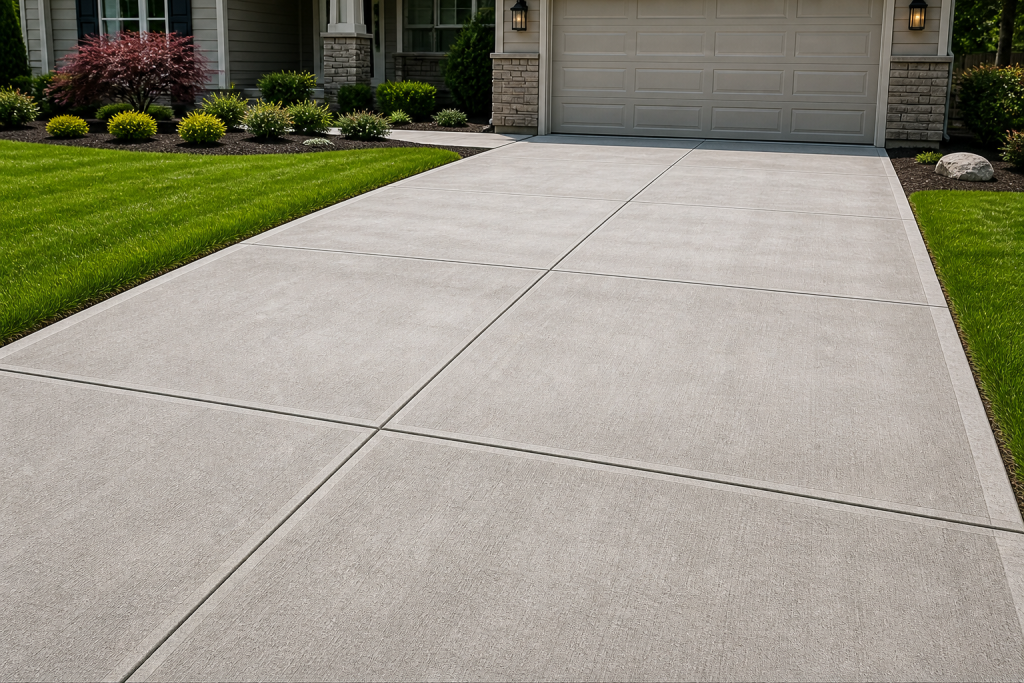
Getting the best value on your concrete driveway does not mean finding the lowest price. It means finding the right combination of quality, service, and fair pricing that gives you a finished product you will be happy with for decades. Here are some practical tips for Northwest Indiana homeowners who want to maximize their driveway investment. Get multiple estimates from reputable contractors who are willing to visit your property and provide detailed, written proposals. An estimate based on a phone conversation or a quick drive-by is not worth the paper it is printed on. Insist on a thorough on-site evaluation and a line-item estimate that you can compare meaningfully against other bids.
Ask detailed questions about the installation process. A quality contractor should be happy to explain their base preparation approach, concrete specifications, reinforcement plan, finishing technique, and curing procedures. If a contractor cannot or will not answer these questions clearly, that is a red flag.
Check references, reviews, and past work. Look for contractors with a track record of satisfied customers in your area, and do not hesitate to ask for photos of completed driveways or addresses of past projects you can drive by. Online reviews on Google and other platforms provide valuable insight into a contractor’s consistency and customer service.
Consider timing your project for optimal scheduling and pricing. Late fall and early spring, when contractor schedules are typically less packed than the peak summer season, may offer more flexible scheduling and potentially better pricing. However, weather conditions must be suitable for concrete work, so discuss timing with your contractor to find the best balance. Invest in quality upfront rather than planning to fix problems later. A well-built concrete driveway with proper base preparation, adequate thickness, appropriate reinforcement, and quality finishing will outlast a cheap installation by many years and cost far less over its total lifespan when you factor in repairs, resurfacing, and premature replacement.
Ready to Start Your Concrete Driveway
If you are ready to get an accurate, detailed estimate for your concrete driveway project, contact Black Rock Concrete today. We provide free on-site consultations and transparent pricing for homeowners throughout Valparaiso, Portage, Crown Point, Chesterton, Merrillville, Hobart, and all of Northwest Indiana. We look forward to helping you make a smart investment in your home.