Signs You Need to Replace Your Concrete Driveway
When Replacement is the Smart Move

Is It Time for a New Driveway? How to Tell When Replacement Is the Smart Move

Your concrete driveway endures more punishment than almost any other surface on your property. Day after day, year after year, it supports the weight of your vehicles, weathers Northwest Indiana’s brutal freeze-thaw cycles, absorbs the corrosive effects of road salt and deicing chemicals, and faces the full spectrum of weather conditions our region has to offer, from scorching summer heat to sub-zero winter cold and everything in between. Given all of this abuse, it is no surprise that even well-built driveways eventually reach the end of their useful life and need to be replaced.

But how do you know when your driveway has crossed the line from needing minor maintenance to requiring full replacement? This is one of the most common questions homeowners in Valparaiso, Crown Point, Portage, Merrillville, Chesterton, Hobart, and throughout Northwest Indiana ask the team at Black Rock Concrete. And it is an important question, because the answer affects both your safety and your finances.
Replacing a driveway too early wastes money on a surface that still has functional years left. But waiting too long can result in safety hazards, property damage, declining curb appeal, and repair costs that approach or even exceed the cost of replacement without delivering the same value or longevity. The key is learning to recognize the warning signs that indicate your driveway is past the point of cost-effective repair and that a fresh start is the smartest investment.
In this guide, we walk through the telltale signs that your concrete driveway is ready for replacement, explain what causes each type of damage, and help you understand when repair might still be a viable option versus when replacement is the better path forward. Armed with this information, you can make a confident, informed decision about the best course of action for your specific driveway.

Widespread Cracking That Keeps Getting Worse
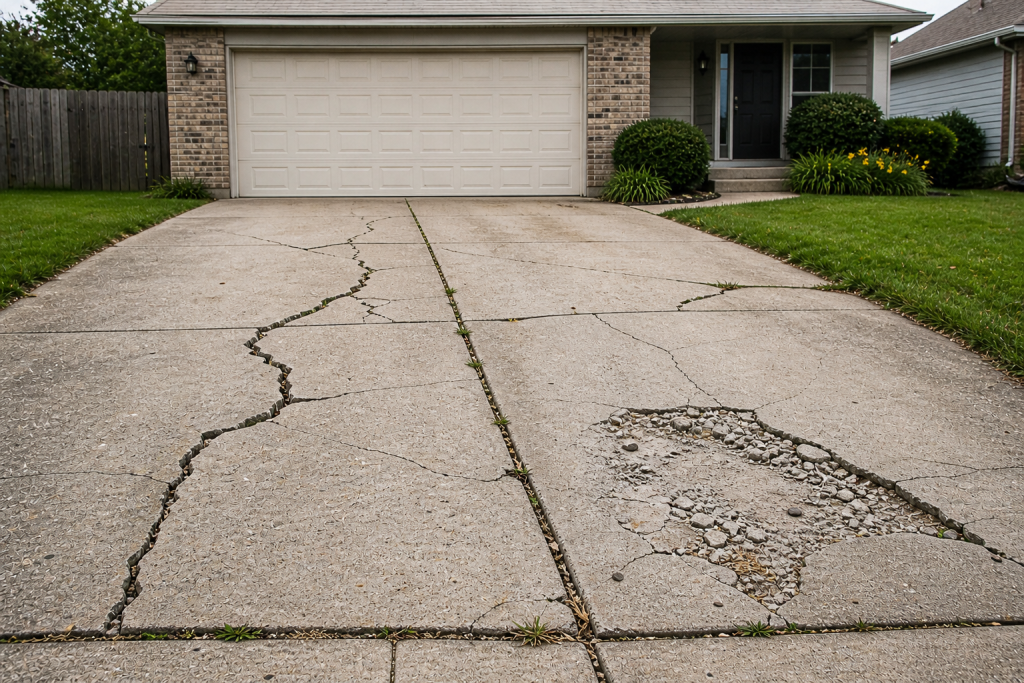
Cracking is the single most common concrete driveway problem, and it is important to understand that not all cracking signals the need for replacement. Minor hairline cracks that are narrow, shallow, and stable are common in concrete and are generally cosmetic rather than structural. These small cracks can often be sealed to prevent water infiltration and extended freeze-thaw damage without requiring more extensive intervention.
However, when cracking becomes widespread, deep, wide, or continues to grow and multiply over time, it is a sign of more serious underlying problems that patching and sealing cannot solve. Structural cracking that extends through the full depth of the slab indicates that the concrete has been stressed beyond its capacity, whether by inadequate reinforcement, insufficient thickness, excessive loads, poor base preparation, or cumulative freeze-thaw damage. Once structural cracking reaches this point, the driveway has lost its integrity and will continue to deteriorate regardless of surface repairs.
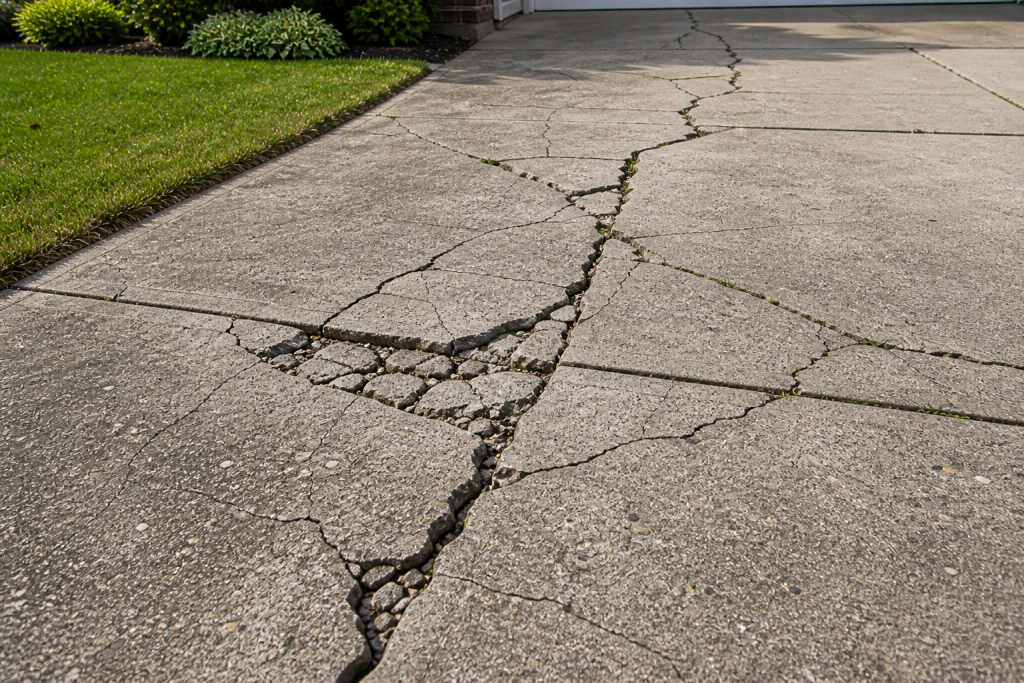
Pattern cracking, also called map cracking or alligator cracking, creates a network of interconnected cracks that resemble the scales of a reptile or the pattern on a dried lake bed. This type of cracking is typically caused by issues within the concrete itself, such as excessive shrinkage during curing, alkali-silica reaction, or severe freeze-thaw deterioration. When pattern cracking covers a large portion of your driveway, the concrete has fundamentally failed and cannot be effectively repaired.
If your driveway has numerous cracks that you find yourself filling and re-filling every year or two, it is worth having a professional evaluate whether the ongoing cost of repeated repairs is approaching the point where replacement would be a better financial decision. In many cases, the cumulative cost of multiple repair cycles over several years exceeds the one-time cost of a properly installed new driveway that will last for decades.
Widespread Cracking that Keeps Getting Worse

Age and Cumulative Wear

Even without dramatic cracking, settling, or surface failure, concrete driveways eventually age out of their useful service life due to the gradual accumulation of wear, minor damage, and material fatigue over many years. The typical lifespan of a residential concrete driveway in Northwest Indiana is approximately twenty to thirty years, depending on the quality of the original installation, the maintenance it has received, the traffic it has carried, and the specific conditions it has faced.
If your driveway is approaching or has exceeded the twenty-year mark and is showing multiple signs of aging including hairline cracking throughout, surface wear, edge deterioration, joint failure, minor settling, and general loss of appearance, it may be approaching the point where continued investment in repairs yields diminishing returns compared to the value of a complete replacement.
Consider the cumulative cost of the repairs you have already made and expect to make going forward. If you find yourself spending money on crack filling, patching, leveling, and other repairs every year or two, those costs add up quickly. At some point, the total investment in band-aid repairs approaches or exceeds the cost of a brand-new driveway that will look great, perform reliably, and require minimal maintenance for the next twenty-five to thirty years.
A new driveway also gives you the opportunity to address any design, layout, or functionality issues with the current surface. Perhaps you would like a wider driveway to accommodate more vehicles, a different shape that better suits your property, a turnaround area that eliminates the need to back into the street, or a decorative finish that elevates your home’s curb appeal. Replacement provides a clean slate to optimize the design for your current needs and preferences.
Age and Cumulative Wear

Severe Surface Deterioration

The surface of your driveway is its first line of defense against the elements, and when that surface begins to fail, the damage accelerates rapidly. Several types of surface deterioration can indicate that your driveway is approaching the end of its useful life. Spalling occurs when the top layer of concrete flakes, chips, and peels away, exposing the rough aggregate beneath. This is one of the most common forms of driveway deterioration in Northwest Indiana and is typically caused by freeze-thaw damage, particularly on driveways where the concrete was not properly air-entrained during mixing. Air entrainment creates microscopic air bubbles within the concrete that provide relief space for water as it freezes and expands. Without adequate air entrainment, the expanding ice creates internal pressure that breaks the surface apart. Heavy use of deicing salt and chemicals accelerates this process significantly.
When spalling covers large areas of your driveway, the surface becomes increasingly rough, unsightly, and difficult to maintain. Loose material continues to break away, the affected areas grow larger over time, and the driveway takes on a deteriorated, neglected appearance that detracts from your home’s curb appeal. While small, isolated spalled areas can sometimes be patched, widespread spalling indicates a fundamental problem with the concrete that cannot be economically repaired with surface treatments. Scaling is similar to spalling but involves the peeling and flaking of thin layers from the surface rather than deeper chunks. Scaling is often caused by the same freeze-thaw and deicing chemical factors that cause spalling and creates a similar rough, deteriorated appearance.
Pitting and pockmarking create numerous small holes and depressions in the concrete surface that trap water, collect dirt, and give the driveway an aged, worn appearance. Severe pitting can make the surface uncomfortable to walk on and difficult to sweep or clean. When the surface deterioration on your driveway has progressed to the point where it affects a significant percentage of the total area, looks consistently rough and worn, and continues to worsen despite maintenance efforts, replacement is the practical path to restoring a safe, attractive, and functional surface.
Severe Surface Deterioration

Significant Settling, Heaving, and Uneven Surfaces

Concrete driveways should provide a relatively smooth, level surface for vehicles and foot traffic. When sections of your driveway begin to sink, tilt, rise, or shift relative to adjacent sections, creating noticeable elevation changes, gaps, and uneven surfaces, it is a clear indication of problems beneath the slab that are likely to continue worsening over time. Settling occurs when the soil or base material beneath the concrete compresses, erodes, or washes away, leaving voids that allow the slab to sink. Settling is often progressive, meaning it continues to worsen as water infiltrates the gaps, further erodes the supporting material, and creates larger voids. Common causes include inadequate compaction of the base during original construction, soil erosion from poor drainage, underground water movement that washes away fine soil particles, and natural consolidation of fill material over time.
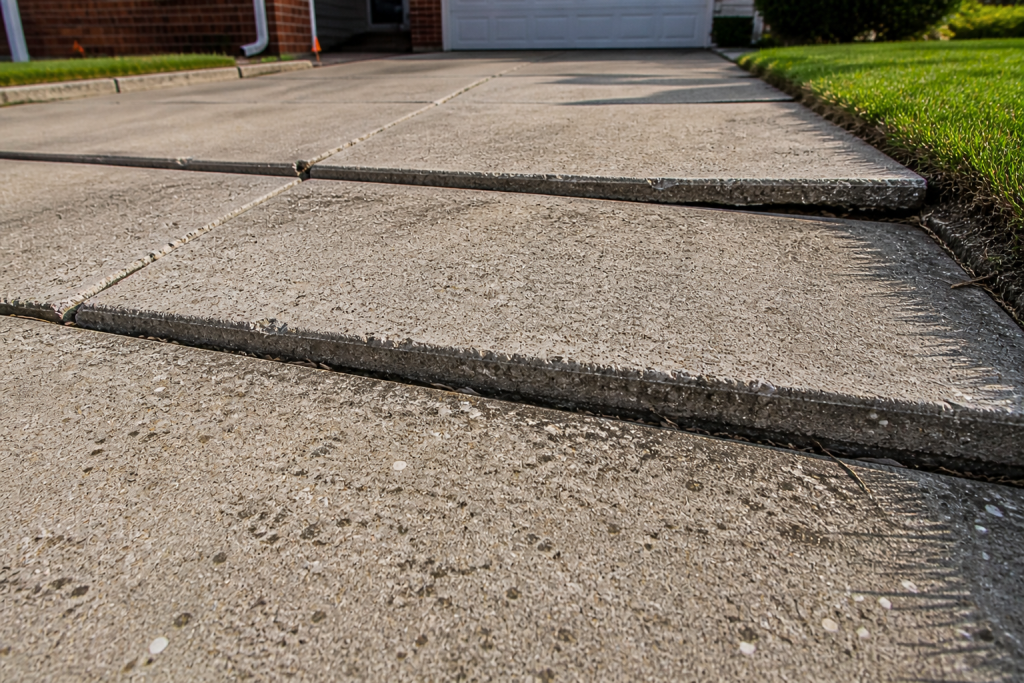
Heaving is the opposite of settling, occurring when sections of the driveway are pushed upward by forces acting beneath the slab. The most common cause of heaving in Northwest Indiana is frost action. When water in the soil beneath the concrete freezes during our cold winters, it expands with tremendous force, lifting the slab upward. When the soil thaws, the slab may partially settle back but rarely returns to its original position, resulting in progressive unevenness over repeated freeze-thaw cycles. Tree root growth beneath the driveway is another common cause of localized heaving. Raised edges, tilted panels, and significant elevation differences between adjacent slab sections create real safety hazards, particularly trip-and-fall risks for pedestrians and potential vehicle damage from sudden surface changes. These uneven conditions also create areas where water pools rather than draining properly, accelerating further deterioration of the concrete.
While techniques like mudjacking or foam injection can sometimes raise settled sections back toward their original position, these methods address the symptom rather than the cause and may not provide a lasting solution if the underlying soil conditions remain problematic. For driveways with multiple settled or heaved sections, widespread unevenness, or ongoing soil problems, full replacement with proper base preparation and drainage correction is typically the most reliable and cost-effective long-term solution.
Significant Settling Heaving and Uneven Surfaces
Drainage Problems that Affect your Foundation

Drainage Problems That Affect Your Foundation

One often-overlooked sign that your driveway needs replacement is persistent drainage problems that direct water toward your home’s foundation rather than away from it. If your driveway has settled, shifted, or been improperly graded to the point where rainwater and snowmelt flow toward your house rather than toward the street or other appropriate drainage areas, you are dealing with a problem that affects far more than the driveway itself.

Water that pools against or flows toward your foundation can cause basement flooding, crawl space moisture problems, foundation wall damage, soil erosion around the foundation, and long-term structural issues that are extremely expensive to repair. If your current driveway is contributing to these drainage problems and cannot be effectively re-graded or corrected in its current condition, replacement with proper grading is an investment that protects your entire home.

When we replace a driveway at Black Rock Concrete, we always establish proper grading that directs all surface water away from the home and toward appropriate drainage areas. This proactive approach to water management protects both the new driveway and the home’s foundation, providing dual benefits from a single investment.

Get a Free Driveway Evaluation

If you are seeing any of the warning signs discussed in this guide, we encourage you to contact Black Rock Concrete for a free, honest evaluation of your driveway’s condition. Our experienced team will inspect your driveway, identify the underlying causes of any damage, and provide a straightforward recommendation on whether repair or replacement is the best path forward for your specific situation. We serve homeowners throughout Valparaiso, Portage, Crown Point, Chesterton, Merrillville, Hobart, Schererville, Munster, Highland, Griffith, Cedar Lake, Lowell, Hebron, Burns Harbor, Michigan City, and all of Northwest Indiana.